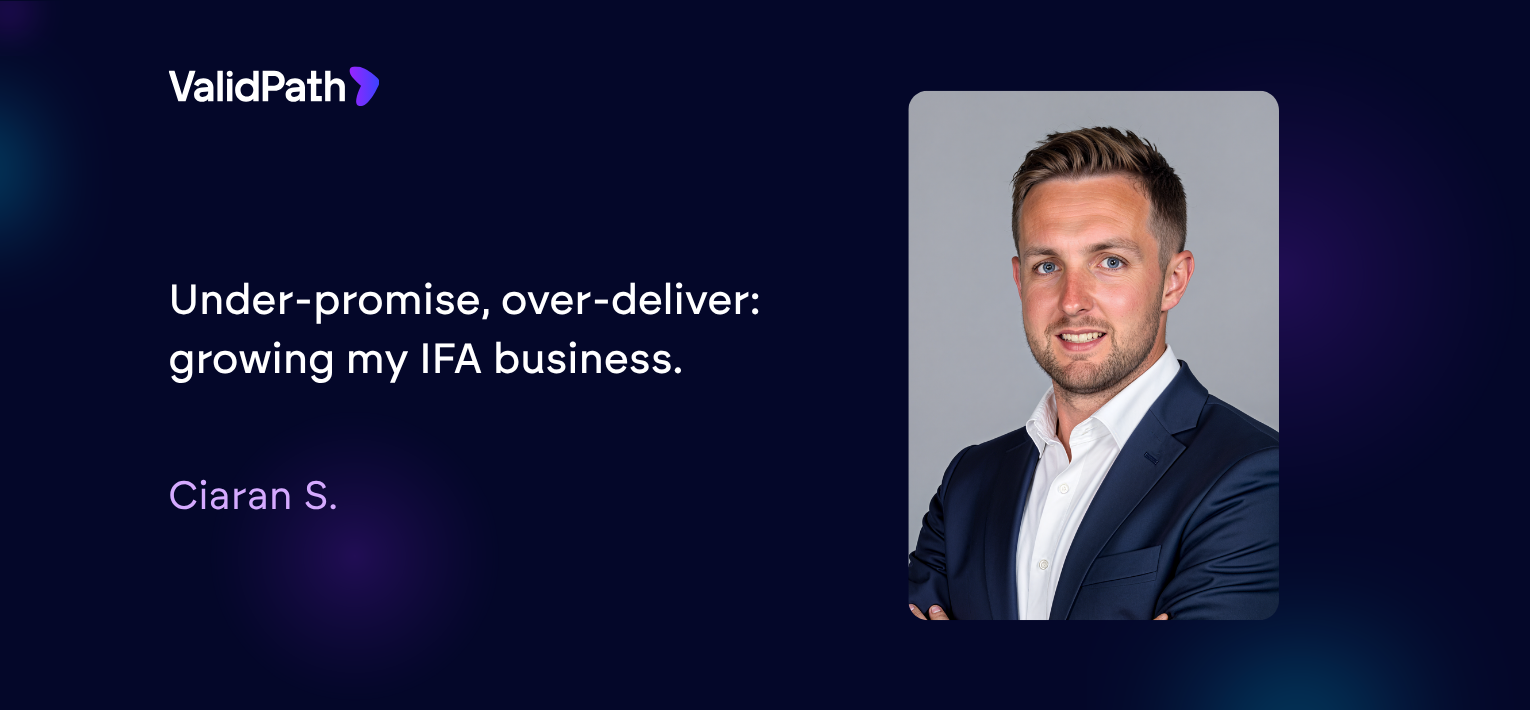
By Ciaran S., ValidPath Member
Ciaran S. is the Founder of his IFA firm. After working in investment management, he moved into financial advice in 2021 and built his client bank from the ground up. He later founded his firm as a ValidPath Member, creating an independent, referral-led firm focused on investments, pensions, tax planning and cash-flow modelling.
Growing a business isn’t about aimlessly adding headcount. It’s about finding people who strengthen what you’ve already built.
We’ve spoken with a number of experienced advisers this year, but we’ve been highly selective about who joins the team and have recruited just one. Qualifications and experience matter, but they’re only part of the equation. We look for people whose approach to advice and commitment to clients align with the culture, values and standards we’ve worked hard to create.
That principle runs through the whole business. We only accept a client when we believe we can deliver more value than the fee we charge. We focus on the areas where our advisers make the greatest difference, and we outsource work that specialists are better placed to perform. We’re also adopting technology quickly, but without giving up control over how it is used.
I didn’t move into financial advice through a conventional route. I started in a client relationship role in Dubai before returning to the UK and joining AXA, followed by Liontrust Asset Management, where I spent five years in investment management, working with advisers, networks and national advice businesses across the country.
Following an acquisition, I left a secure salaried position and became a self-employed adviser in 2021. I had no salary and was responsible for finding and serving every client myself. I spent just over two years building that client bank before launching Fornells Wealth Management.
That experience gave me the practical foundation I needed, but my long-term goal was always to build a business rather than remain a sole adviser. These are the principles that have helped us do that.
Decide where you genuinely add value
One of the most important decisions we made was being clear about what our advisers should and shouldn’t do.
Fornells focuses on investments, pensions, tax planning and cash-flow modelling. Protection is important, and we will always identify when a client has a gap that needs addressing, but we refer that work to a specialist rather than trying to provide advice in an area we aren’t working in every day.
I don’t believe being qualified to advise on something automatically means you should.
It’s difficult to be genuinely good at an area unless you’re interested in it, understand it in depth and work with it consistently. Trying to cover everything can spread advisers too thinly and weaken the value they deliver in the areas where they’re strongest.
When I first spoke to ValidPath, I was very clear about the areas in which I wanted to advise. The Network was comfortable supporting a more specialised proposition rather than expecting us to offer every possible service.
That ability to define our own proposition was important. A growing firm needs a clear identity, and that starts with understanding where it can make the greatest difference for clients.
Let specialists handle work they can do better
My background is in investment management, and I hold investment management qualifications. Even so, our centralised investment proposition is built around outsourcing portfolio construction and asset allocation to specialist investment managers.
Our role as advisers is to understand what clients want to achieve and help them make good decisions around tax planning, cash flow, pensions, investments and risk. Those are the controllable areas where we can add genuine value.
There can sometimes be confusion about where the adviser’s role ends and the investment manager’s begins. Building a portfolio from individual sector and strategy funds isn’t necessarily the best use of an adviser’s time, even when they have the technical ability to do it.
Don’t get me wrong, it’s very important to have a granular understanding of what you’re recommending and why you’re recommending it, so there are no surprises. Given our background, we are subject matter experts in asset allocation and portfolio construction, so we have a deep understanding of how portfolios are built and how different asset allocation decisions influence outcomes.
That expertise enables us to assess and recommend portfolios with confidence. However, we don’t see constructing portfolios as the role of our advisers, and we make that distinction very clear.
Someone else can specialise in constructing and managing the portfolio. That leaves our advisers free to focus on financial planning and the client relationship.
The question shouldn’t only be whether you can perform a particular task. It should be whether you’re the right person to perform it, and whether doing so is the best use of your time.
Only accept clients when you can deliver more value than you charge
We don’t accept business simply because it’s available or because we can generate revenue from it. One of the clearest lessons I’ve learned about how financial advisers can grow their client base is that client referrals are earned by consistently delivering more value than you charge.
We don’t carry out outbound prospecting. All our new business comes through existing clients and professional connections.
I describe it as “people of people”. Everyone within the client base is connected in some way because another client or trusted professional has introduced them.
That creates a very different growth model. When clients believe they have received clear, tangible value, they’re more comfortable recommending you to somebody they know. The firm grows through the strength of the service rather than the volume of its outreach.
It also creates accountability. A referral arrives with an existing level of trust, and you have to justify it.
To grow your client base as a financial adviser, the aim shouldn’t be to build the largest possible client bank. It should be to work with the right clients and consistently deliver enough value for those relationships to deepen and generate further introductions.
Know when to stop growing your own client bank
When I left investment management, I knew I ultimately wanted to build an advice business. But I also knew I couldn’t credibly lead other advisers without first doing the job myself.
I spent more than two years building a client bank from scratch, learning what it meant to find clients, deliver advice and take responsibility for those relationships.
That experience was essential, but it was never meant to be the final business model. There is a real distinction between being an adviser and being a business owner.
An adviser focuses on delivering advice. A business owner has to think about recruitment, infrastructure, liability, efficiencies, processes, team development and where the firm is heading next.
You can perform both roles for a period, particularly during the early stages. But if you want to create a firm that can grow beyond you, you eventually have to make a conscious choice about where your time should go.
Recruit for alignment, not speed
Fornells has grown from a business consisting only of me to a wider team of advisers and operational support.
We are now a team of five advisers with administrative and paraplanning support within the business.
We could have recruited more quickly. But bringing somebody into the firm simply because they have clients, qualifications or commercial potential would create a much greater risk later.
Our advisers need to believe in the same client-centred model. They need to understand why we specialise, why we outsource portfolio construction and why we refuse work when we can’t demonstrate sufficient value.
That is why multiple interviews produced one appointment.
My principle is to under-promise and over-deliver. I don’t want to recruit somebody on a false premise or suggest the business will provide something it can’t. Equally, I don’t want an adviser joining and discovering that their preferred way of working conflicts with what Fornells stands for.
Recruiting slowly isn’t a failure to grow. It protects the quality and direction of the business while it grows.
A quick appointment can increase headcount. The right appointment strengthens the firm.
Protect the independence behind your proposition
Before becoming an adviser, I worked with many of the major networks, national firms and service providers. That gave me a strong understanding of how different models operate.
For me, the value of independence is being able to sit in front of a client and know that every recommendation is being made purely on merit, with no ties to a provider or pressure to use a particular solution.
My view is that an adviser working within a restricted proposition is ultimately acting as an agent for that provider. That doesn’t automatically make restricted advice wrong, but it wasn’t the model I wanted to build.
That was one of the main reasons I chose to join ValidPath after assessing the major network options.
I wanted the Network to be hands-off while the business was operating well, but responsive when we needed support. ValidPath has allowed us to retain control over our proposition and how we run the firm while remaining available when questions or challenges arise.
A network should give an independent firm the infrastructure to deliver its own proposition. It shouldn’t gradually push the business towards somebody else’s.
Examine barriers to growth before you start scaling
Before bringing more advisers into Fornells, I wanted to understand the liabilities and responsibilities the firm would assume.
That included looking closely at ValidPath’s professional indemnity policy.
At the time, different types of advice carried staggered policy excesses. I was concerned that this could create a potential conflict if an adviser knew one recommendation would carry a significantly higher excess than another in the event of a future complaint.
We have never had an upheld complaint and don’t plan to have one. But as a business owner, I still needed to understand the risk involved in taking responsibility for the advice delivered by a growing team.
I raised the issue with Richard Phillips, ValidPath’s Network Development Director, and later discussed it with Angus MacNee, ValidPath’s CEO, and others within the Network. They listened to the concern, asked for feedback and explored what could be changed.
A few months later, ValidPath overhauled the policy structure and introduced a flat excess across the different areas of advice.
That was significant for us because it removed a potential barrier to scaling the firm. It also showed the value of having an open relationship with your network rather than quietly accepting that an existing process doesn’t fit the business you’re building.
My advice is to consider these questions before you grow. What changes when another adviser joins? What additional liability will the firm carry? Are the policies and processes that worked for one adviser still appropriate for five?
It is much easier to address those issues before they become an obstacle.
Use the community to challenge how you work
I don’t consider myself a technology expert. My strengths and interests are financial markets, financial planning, advice and building businesses.
I’m comfortable admitting that, because I don’t believe anyone has a monopoly on good ideas.
Part of building a strong team is surrounding yourself with people who understand areas that you don’t. The same applies to the wider ValidPath Member community.
ValidPath’s events are useful because they expose you to Members and speakers with different experiences and strengths. You don’t have to copy everything you hear, but one contribution can make you examine a process or problem differently.
At the Annual Member Event held at The Dorchester, a speaker discussed how firms could use technology more effectively. That session changed the way I thought about our own processes.
Compared with where we were a year ago, the business is now almost unrecognisable in terms of its systems and efficiency. Change has happened at an extraordinary pace, and I expect that to continue for the foreseeable future.
The value of attending an event isn’t simply hearing ideas you already agree with. It is finding somebody who understands an area better than you do and allowing that perspective to challenge and influence how your business operates.
Use AI to reduce administration, but keep control
AI for financial advisers can remove a significant amount of administration when it is used with the right controls. At Fornells, we use the business version of ChatGPT across several areas of the firm.
We remain cautious about the information entered into any AI tool and don’t use the free versions for business activity. Even with a paid business account, the person using the technology still needs to understand what is being provided and review what comes back.
One practical example is suitability reporting.
We can take the answers from a client’s risk questionnaire and use ChatGPT to help draft sections covering areas such as capacity for loss, investor experience and knowledge.
Two or three years ago, writing one of those sections properly could take close to an hour. The initial draft can now be produced in approximately 15 seconds.
That doesn’t mean the adviser can accept the output without question. The speed is only valuable if the information entered is accurate, the prompt is appropriate and somebody with the necessary expertise reviews the result.
AI is only as good as the person using it.
Regular use also matters. I spent a considerable amount of time working with ChatGPT, refining how I prompted it and showing it the type of output I expected. As that process developed, it became much more useful to the business.
There is no shortage of AI tools for financial advisers, but we’re reluctant to commit too early to one specialist vendor. The technology, commercial models and ways data is used are changing incredibly quickly.
For now, I prefer tools where we control the inputs and can scrutinise the outputs. I don’t want to rely on a system built around prompts, values or assumptions that we haven’t been able to examine ourselves.
AI can dramatically reduce administration, but the firm must remain accountable for the work it produces.
Build growth around alignment
For me, sustainable growth comes back to alignment.
Your clients need to align with the value your firm provides. Your advisers need to align with the proposition and principles of the business. Your network needs to support how you want to operate, and your technology needs to strengthen your process rather than dictate it.
That doesn’t mean everybody has to think in exactly the same way. A good firm needs different experiences, ideas and strengths. But people need to agree on the fundamentals: whose interests come first, what good advice looks like and what the business is trying to achieve.
Fornells has grown by being selective. We’ve been selective about the clients we accept, the services we offer, the advisers we recruit and the tools we adopt.
That can make growth look slower from the outside. But it creates a stronger foundation because each new addition is moving the business in the same direction.
Under-promise, over-deliver and don’t add something to the firm unless it strengthens the value you provide.
While I may spearhead the business, its success has never been about one individual. Building a strong, collaborative team where everyone is encouraged to contribute ideas, challenge thinking and help shape both the business and our client proposition has been fundamental to our growth.
Every member of the team brings a unique perspective and expertise that strengthens the advice we deliver and the experience we provide. Equally, without the trust and support of our valued clients, none of this would be possible. Together, our team and our clients have played an integral role in making the business what it is today, and they’ll continue to shape where it goes next.
My advice for advisers
- Be clear about where you and your firm deliver the greatest value.
- Don’t provide every service simply because you’re qualified to do so.
- Let specialists perform work that isn’t central to the adviser’s role.
- Only accept clients when you can demonstrate value beyond the fee charged.
- Decide whether you want to grow your own client bank or build a firm that can operate beyond you.
- Recruit for shared morals, standards and principles rather than speed.
- Review your infrastructure, policies and liabilities before expanding the team.
- Choose a network that protects your independence and responds when support is needed.
- Learn from people whose strengths and experience differ from your own.
- Use AI to reduce administration, but retain control over the inputs, outputs and final advice.
Grow your financial advice business with ValidPath
ValidPath gives Independent Financial Advisers the freedom and support to build firms around their own propositions, with access to compliance support, integrated technology, an active Member community and practical guidance for business growth.
Speak to ValidPath to learn how the Network can support you to start, run and grow your independent financial advice business.