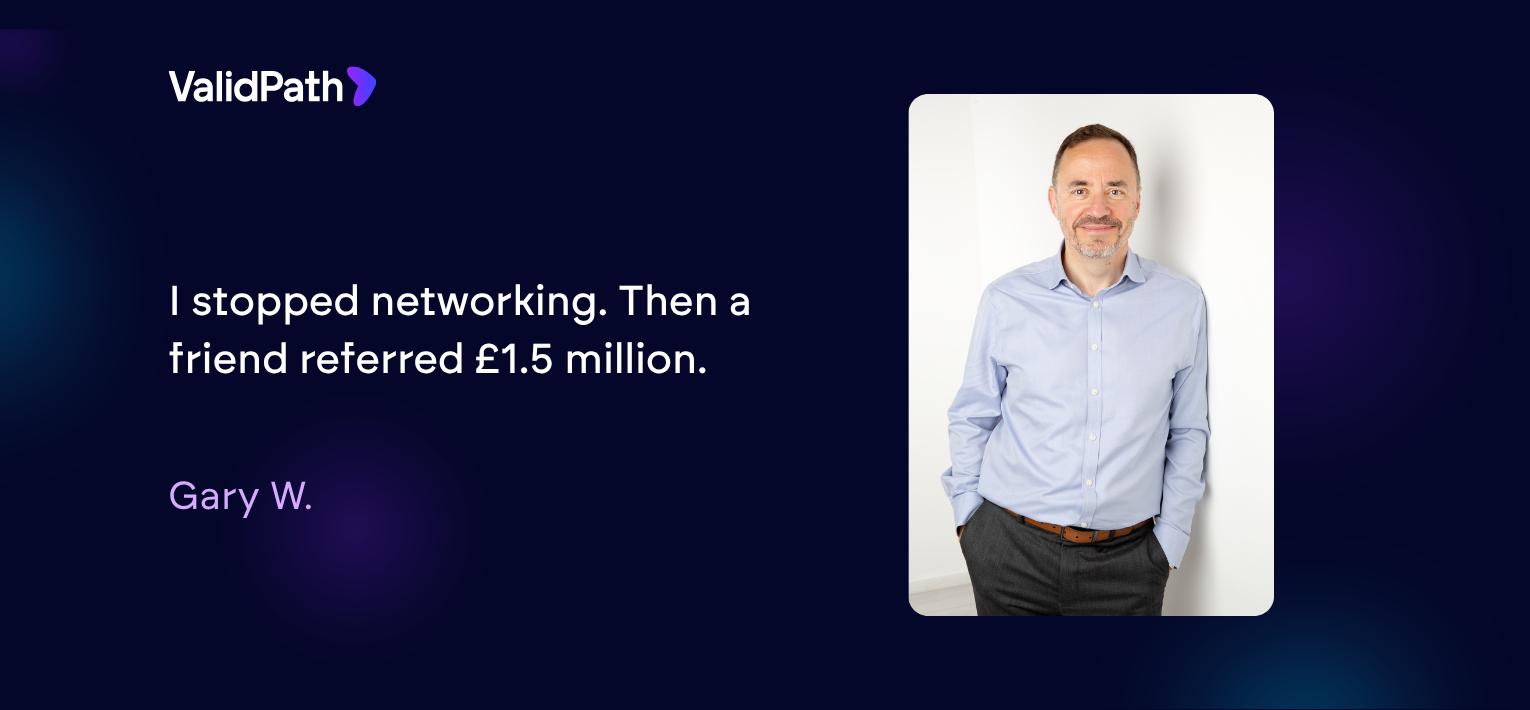
By Gary W., ValidPath Member
Gary W. is Director and financial adviser at his IFA firm. With more than a decade of experience in regulated financial advice, Gary focuses on building long-term relationships and helping clients use their money to live richer, more fulfilling lives through personal, independent financial advice.
A man I’ve known for nearly 20 years recently referred two clients to me with around £1.5 million to invest. I had never asked him for business. In fact, we’d barely spoken about work.
We met through a small social group that has been getting together for years. There are about nine of us, I’m the youngest by some distance and the oldest is now 86. We used to call it The Curry Club, although we stopped going for curry a long time ago.
One of the group had spent his career as a tax adviser. While he was working, he referred clients to his own firm’s financial planning team. After retiring, he suddenly introduced two of them to me.
I can only assume he decided I was someone he could trust with his reputation.
That means far more to me than any lead generated through a networking strategy. It also sums up what I’ve learned about how financial advisers can grow their client base: through genuine relationships, good service and being somebody people feel comfortable recommending.
Why I stopped forcing myself to network
A lot of business growth advice is based on developing professional connections, attending networking meetings and treating every new relationship as a potential source of referrals.
I understand the logic. It just doesn’t feel authentic to me. I don’t absolutely avoid networking, but I don’t like it, do it very rarely, and certainly don’t think it works for me.
I trust my gut more than I used to. People can make a perfectly logical case for something, and my head will tell me I should do it. But if it doesn’t feel right, it rarely goes anywhere.
Formal networking has always felt like that. I don’t want to meet somebody while quietly wondering whether they could become a client or send business my way. The relationship feels compromised before it has even started.
So, over time, I’ve largely stopped doing it.
Almost all my business still comes through referrals, but those referrals tend to come from people who know me rather than connections I’ve deliberately developed for commercial reasons.
I focus on being myself, looking after people properly and trusting that the rest will follow. That isn’t necessarily the right approach for every adviser, but it’s the only one that feels sustainable for me.
Why genuine community matters most
Avoiding formal networking doesn’t mean I want to build my business in isolation.
What I value is being around people who speak honestly about how they work, share perspectives I wouldn’t otherwise hear and help me test whether my own instincts make sense.
I saw that at a ValidPath event in Manchester where we were discussing business development. Much of the conversation focused on the activities firms were using to generate new opportunities. None of it was wrong, but none of it was really speaking to me either.
Then the conversation reached one of the other attendees.
When he was asked about his approach, he was refreshingly honest. He said he didn’t really do formal networking or spend his time on lots of business-development activity. He just concentrated on his existing clients and gave them as much time as they needed.
That immediately made sense to me.
He wasn’t saying the other approaches were wrong. He had simply built his business in a way that suited him and worked for his clients. I’ve met with him since, and we’ll meet again.
That’s what a genuine community gives you. Sometimes it challenges your thinking. Other times, it introduces you to somebody whose experience confirms that the instincts you already have are worth listening to.
ValidPath’s community didn’t just confirm my instincts – it pushed me to start using AI
The community hasn’t only confirmed what I already believed. It has also made me uncomfortable in useful ways.
At an earlier ValidPath event nearer to me in Wilmslow, I was sitting around a table while several other Members discussed AI for financial advisers and the different systems they were using.
At that point, I wasn’t doing anything with it. I didn’t understand most of the tools they were talking about, and I had no idea where to start.
I came away feeling uncomfortable because I suddenly understood how quickly the world around me was changing. I wasn’t on that bus, and I needed to develop a better grasp of what was happening.
That started the journey for me. ValidPath’s Annual Member Event added more practical detail and helped me begin filtering the growing number of AI tools for financial advisers into the ones that could genuinely help my business.
I now use PlannerPal alongside ChatGPT Pro.
My Zoom meetings are linked to PlannerPal, which records the meeting, produces a transcript and creates draft client notes and an executive summary. I also have annual-review documents and ValidPath’s before-and-after circumstances templates within the system.
It isn’t the most elaborate tool available, but I rarely use every feature in an all-singing, all-dancing system anyway. ValidPath has made PlannerPal available to Members at a reduced fee, and for what I need, it works well.
I still wouldn’t trust AI in its entirety.
The first draft of a meeting note doesn’t sound like me, so I take the output into ChatGPT and work on it until it does. I’ve used ChatGPT for around 18 months and even asked it to interview me to help define my values and understand how I want the business to sound.
The most important part is still the time I spend going backwards and forwards, removing wording that feels pompous or inauthentic.
A friend taught me that lesson very directly. I used to pay around £300 a month for a prepared newsletter. One day, he told me he never read it.
When I asked why, he said: “It doesn’t sound like you. It’s just something somebody else has made.”
You can always rely on your friends to give you clarity.
AI can save me time, but it can’t save me care or attention. The technology is useful because it gives me more time to focus on the human part of the job. It shouldn’t take that part away.
The same sense of community carried through to ValidPath’s support teams
Before setting up my own business, I had advised clients and led a financial advice team. I understood the importance of acting in a client’s best interests and producing work I was proud of, but I hadn’t previously been responsible for the same level of detailed compliance and record-keeping.
When I joined ValidPath and began using Xplan, that gap became clear very quickly. I had around 20 existing clients to bring across, so rather than worrying about new business, I focused on putting those cases through the system properly and learning from real examples.
I also recognised early that I needed more hands-on support. I went back to Rory Jackson, the Network Development Manager who had recruited me, and explained what would help. He understood and connected me with the right people.
Mortgage and Protection Specialist Karen Ferguson and her colleagues became contacts I could approach with practical questions. I could say: “Can you give me ten minutes? This is what I’m trying to do, and this is where it has gone wrong.” Karen would identify the issue, explain what needed changing and help me move forward.
The same has been true of the Compliance team. Compliance was the area where I initially felt least confident, but the relationship has always felt positive. They want to get the advice and the evidence right, while working with me to understand how to achieve that. It feels as though we’re in it together.
I’ve spent most of my career working in large teams, so suddenly working alone could have felt isolating. Between the Member community and ValidPath’s support teams, I’ve always felt part of something bigger and able to ask questions without being judged for not already knowing the answer.
I measure success by whether clients live more richly because of me
I recently had a client come into the office who is unwell and preparing for treatment. She was frightened, feeling low and facing a period of around six weeks in isolation. She needed to get out of the house, so I told her to come down and have a coffee.
We didn’t talk about business at all.
That meeting was about how she felt, not her investments. For me, that is as much a part of the relationship as the financial advice.
Nobody is going to build a statue of me. My lasting impact on the world will be limited, as it is for most people. That naturally leads you to ask what all the work is actually for.
My answer is that I want to look at myself and feel I’ve made some difference.
Getting as many clients through the door as possible and making as much money as possible doesn’t interest me. I want to know whether people feel better for having met me.
Will they live life a little more richly or more colourfully because of the conversations we’ve had? Are they using their money to live the best life they reasonably can?
That is how I measure success now.
The commercial results still matter because the business has to work. But I don’t want the financial target to become the reason for the relationship.
When you stop worrying about what every interaction might generate, you can focus on reassuring people, challenging them and helping them understand what they really want from their lives.
That, for me, is the rewarding part of being an adviser.
I still want to run the business my way – just not on my own
There’s no single right way to build an advice business.
Some advisers thrive on networking and structured business development. I prefer to focus on existing relationships and trust that good service will lead to new opportunities.
What I value about ValidPath is being around people who approach things differently. Sometimes that confirms my instincts. Other times, it pushes me to try something new, as it did with AI.
The same is true of the support teams. When I’ve needed help with compliance or Xplan, I’ve had people I can turn to.
I still make my own decisions and run the business according to my values. I just don’t have to work everything out alone.
Speak to ValidPath about how the Network can support you to grow your IFA business your way, with practical support and a strong Member community around you.