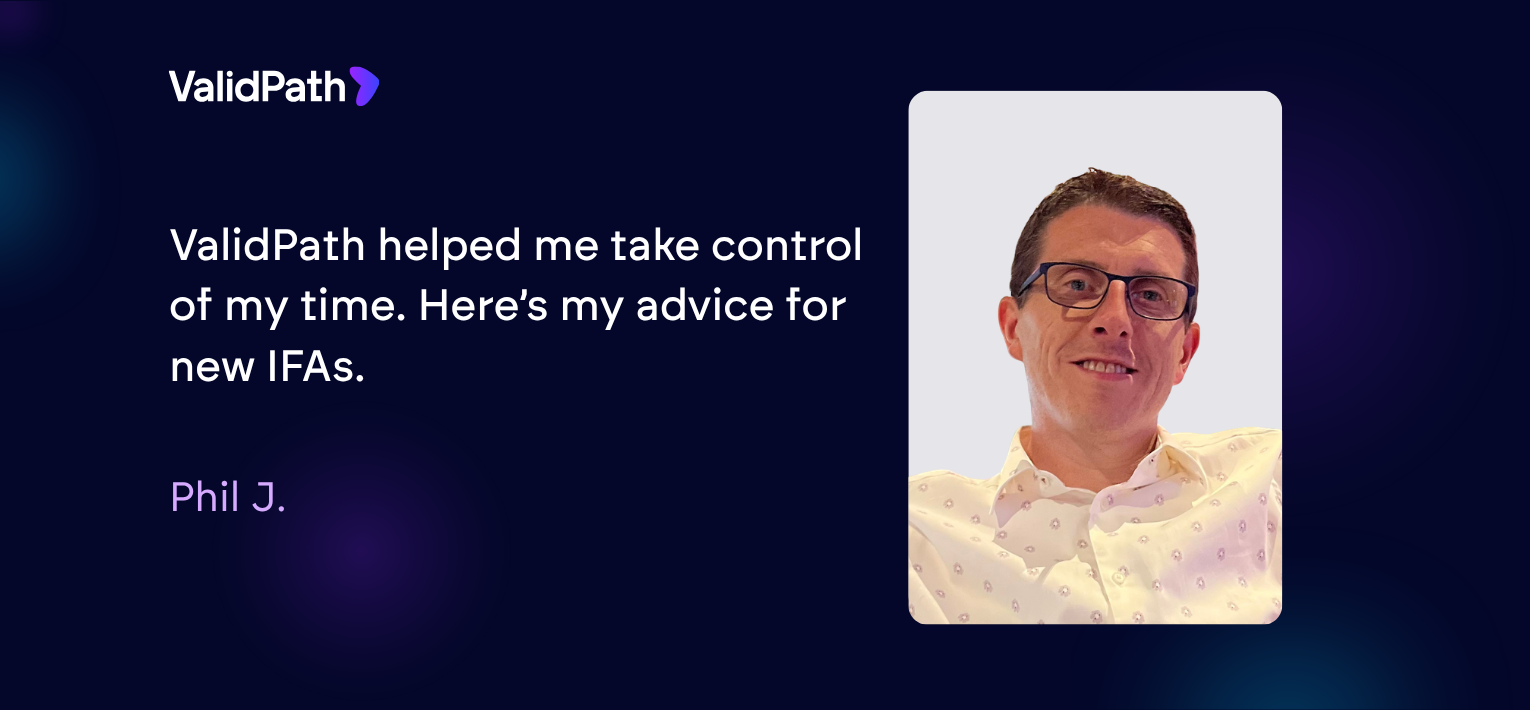
By Phil J., ValidPath Member
Phil J. is the Founder of IFA firm. With more than 25 years’ experience in financial services, Phil has worked across tied advice, accountancy-backed financial planning businesses, and senior employed roles before setting up his own independent firm. Phil founded his firm deliver clear, personal advice on his own terms, with greater control over the proposition, technology, and client experience, as well as how work fits around the rest of his life.
For the last few years of my employed career, I found myself saying the same thing to clients over and over again: the most valuable thing you have is time.
We spend our lives as advisers asking people what they actually want their money to do for them. What do you want life to look like? What matters to you? Are you spending your time in the way you want to spend it?
Eventually, I had to ask myself the same questions.
I was working around five and a half days a week. I have two daughters with quite a big age gap. With my eldest, I attended sports days, assemblies, and all those normal school things. With my youngest, work had gradually taken up more of that time.
Could I have changed things within my employed role? Maybe. I loved the people I worked with, I loved the clients, and I was well rewarded. But there was something else going on too. I wanted to know whether I could do it myself.
I’d spent more than nine years at advice firm Dodd Wealthcare and had set up its Penrith office from effectively no client base. By the time I left, it was generating around £500,000 a year in turnover. I can look back at that and be proud of what I built – but ultimately it was somebody else’s business.
I had my own thoughts about fees, investments, technology, and what I wanted clients to get from financial advice. I wasn’t saying my way was right and everybody else was wrong. I just wanted the freedom to put those ideas into practice.
That was why I decided to set out on my own and start my IFA firm, LEAP Financial Planning.
Choosing ValidPath was part of making that possible. I spoke to around eight networks, and what stood out was that ValidPath was comfortable with me building the business around my own proposition. I could retain the independence I had left employment to achieve, while having the support of the Network and other Members around me when I needed it.
I’m still relatively early in that journey. That, I hope, makes some of the lessons I have learned more useful. The things I would do differently are still fresh.
If you’re a new IFA, or you’re thinking about leaving an employed role to build your own independent firm, here’s the advice I’d give you now.
Be clear about what you want independence to give you
Going independent wasn’t just about working fewer hours.
Running your own firm gives you plenty to do. In my first few months, I went from having administrative and paraplanning support around me to being responsible for far more of the business myself.
For me, the important thing was control.
I wanted control over the investment decisions I made, the solutions I used, the technology behind the business, how clients were charged, and what the experience of dealing with LEAP actually felt like.
I wanted more control over my time too.
Those two things went together. I didn’t want to build my own firm simply for the sake of saying I owned a business. I wanted the business to reflect how I thought financial advice should be delivered and give me more choice over how work fitted around the rest of my life.
If you’re considering the same move, work out what you’re actually trying to change before you do anything else.
If it’s your proposition, what would you do differently? If it’s your working life, what do you actually want that to look like? If it’s ownership, what are you hoping to build over the next five or ten years?
You’ll make a lot of decisions when you start your own firm. Having a clear reason for doing it makes those decisions much easier. Once I knew what I wanted, the next question was whether the network I joined would actually let me build it.
Know your non-negotiables before you choose a network
I spoke to around eight networks before choosing ValidPath.
A lot of them sounded broadly similar at first. Then you got into the details and found that there was often something they expected you to use, whether that was their technology, their platforms, or their way of doing things.
For me, that defeated part of the point of going independent.
I’d already spent years of my career in tied advice, where what we could offer was very restricted. I didn’t want to leave an employed role, create my own firm, and then find that somebody else was still dictating what the building blocks had to look like.
When I spoke to Richard Phillips at ValidPath, the message was essentially this: you’re independent, show us that what you want to do works, and that’s fine.
That was what I wanted to hear.
Your non-negotiables might be completely different from mine, but work them out before you choose a network. Be clear about the decisions you want to retain, where you’re happy to adapt, and where you’ll genuinely need support. For me, ValidPath has given me the structure around LEAP without taking away the autonomy I started the business to achieve.
Of course, choosing a network is only the beginning. The next surprise is how different it feels when you’re responsible for the whole business rather than just the advice.
Don’t rush to fill your diary
This is probably one of the biggest things I’d do differently.
In my employed role, I was averaging 11 or 12 client meetings a week. Then I started LEAP, and suddenly it was one or two.
That feels strange. When you’re used to being busy, your instinct is to fill the diary again as quickly as possible.
At the same time, I’d gone from having other people doing administration and paraplanning to having to learn Xplan from scratch and work out how the whole business was going to operate.
Looking back, I should have made even better use of that quieter period. If I had those first few weeks again, I’d spend them getting the foundations boxed off before worrying too much about onboarding clients.
Learn the systems properly. Decide how reports and administration are going to work. Get clear on your Centralised Investment Proposition. Decide which platforms you actually want to use.
Nine months in, I had much more clarity around all of those things. I wish I’d got more of them sorted in the first two or three weeks.
Your diary will fill up. Use the time before it does to build the business you want to be running when you’re busy again.
Set the business up from day one as though you’re going to sell it
This was advice I heard from a couple of people I respect in the industry: set the business up from day one as though you’re going to sell it.
That doesn’t mean you need your succession plan before you’ve even got started. The point is to build something that is organised, consistent, and easy for somebody else to understand rather than creating unnecessary complexity because you can.
Platforms are a good example. If you put client money across seven or eight different platforms, you then have seven or eight different platforms to administer.
You don’t need to do that to prove you’re independent. If one or two platforms can genuinely meet the needs of your clients across thousands of investment options, working with fewer providers can make the business much easier to run and the client experience much more consistent.
And service has to be part of that decision. I’m currently moving nine clients away from one platform because the service simply hasn’t been good enough compared with the providers I want to work with.
Clients don’t really care which third party has caused the delay. They’ve asked you to get something done. If a platform lets you down, eventually it reflects on your business. I value providers where I can speak to somebody, get a sensible response, and trust them to deliver the level of service my clients expect.
So build simply from the beginning. Think about whether your processes, platforms, and providers will still make sense when the business is bigger. Even if you never sell it, you’ll have created a much easier firm to run.
Ask advisers further ahead what they wish they’d known
Another thing becomes obvious quite quickly when you start your own firm: you don’t know what you don’t know.
I’d spent more than 20 years in financial services. I knew how to advise clients. That didn’t mean I’d previously had to make every decision about systems, platforms, processes, administration, and how an independent business fits together.
So I started asking people.
One ValidPath Member has been particularly helpful. I knew him before I joined because we had both worked for rival accountancy firms with financial planning arms, but he’d been with ValidPath longer than me. He’s been brilliant with his time and with explaining what he’s done, what has worked, and what hasn’t.
I’ve done the same with people outside ValidPath who have been running independent firms for 10 or 15 years. I’ve basically asked them, probably a bit cheekily: what would you tell yourself now that you didn’t know when you started?
It’s a simple question, but the answers can save you a lot of unnecessary trial and error.
You don’t need to copy somebody else’s business. The whole reason I started LEAP was to build something around my own ideas, but independence doesn’t mean making every decision in isolation.
That has been one of the most useful things about the ValidPath community. There are Members who have already dealt with some of the decisions I’m facing now. I can ask what they did, take the bits that are useful, ignore the bits that don’t fit LEAP, and then make my own decision.
At the end of the day, you don’t get extra points for learning every lesson the hard way.
Use technology to give clients more of your attention
I’m not somebody who uses AI for everything, but there is one area where I think integrated technology can make a real difference: meeting recording and note-taking.
If the technology can take care of capturing the conversation, I can sit back and properly engage with the client. That’s what matters.
When you’re sitting with your head down trying to write notes while somebody is talking, you miss things. Sometimes the most important part of the conversation is the hesitation before somebody answers, the way they react to something, or the emotion behind what they’re saying.
That detail helps you understand the client properly. I probably learned the importance of that before I ever became an adviser.
In my early 20s, I was working at a dairy in Penrith and helping with my parents’ milk round. We dealt with people from completely different backgrounds, and you learned quickly that you couldn’t talk to everybody in the exact same way.
You had to listen, adjust how you asked questions, and understand who was in front of you.
It was actually through my parents’ adviser that I ended up in financial advice. I became more interested in my own ISAs and investments, started asking questions, and, during one meeting, one of his colleagues asked whether I’d ever thought about doing the job myself.
More than 24 years later, the technology around the profession has changed enormously. The importance of properly listening to people hasn’t.
Use technology to give yourself more opportunity to do that, not less.
Build your independent financial advice business with ValidPath
Starting LEAP has given me the opportunity to build a business around my own ideas about financial advice and have more choice over how I spend my time. There’s been plenty to learn, and there still is.
What’s helped most is being able to retain control over the business while having people around me to ask when I don’t have the answer, whether that’s within ValidPath itself or through the wider Member community.
If you’re considering setting up your own independent financial advice firm, speak to ValidPath about joining the Network and the support available as you build your business.