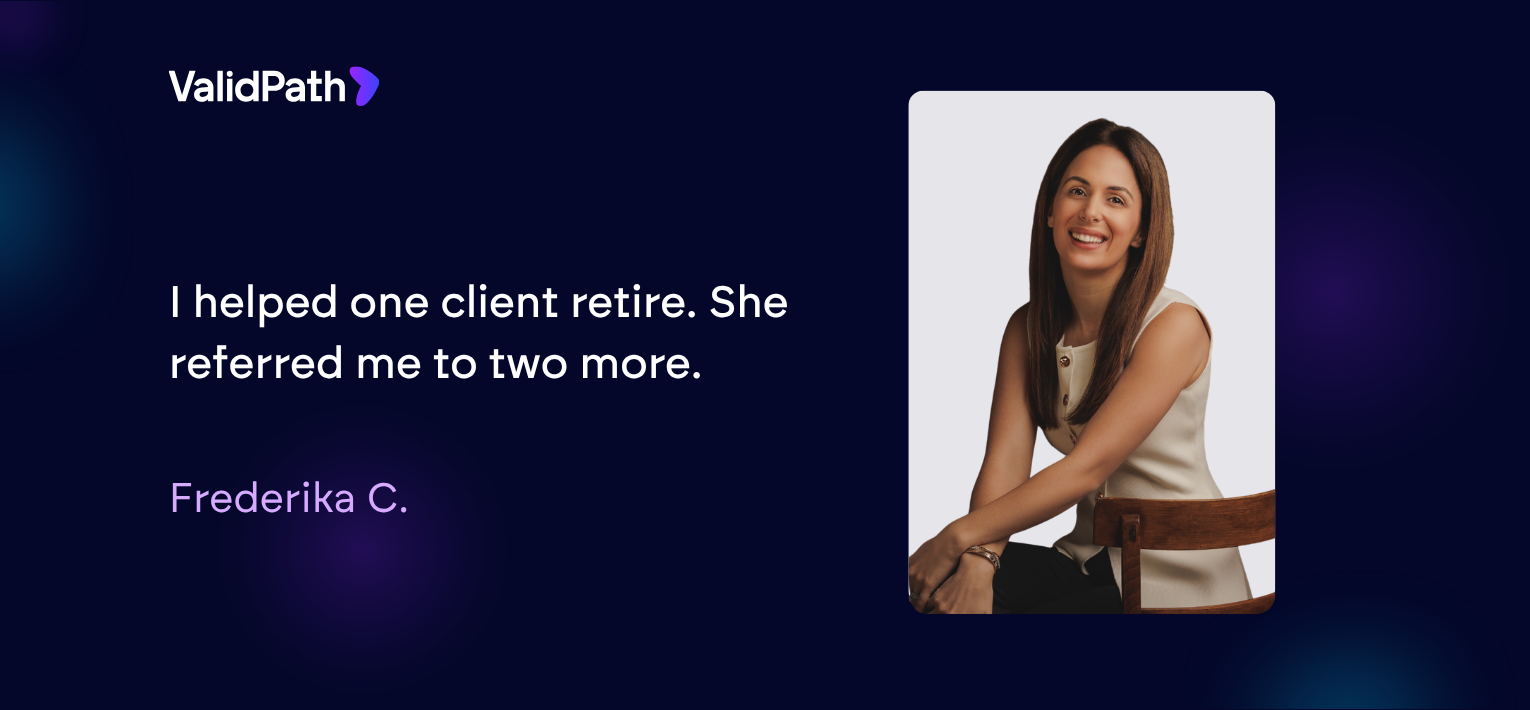
By Frederika C., ValidPath Member
Frederika C. has spent nearly 20 years in financial services, with experience across retail banking, investment management, network operations, and financial advice. A Fellow and Chartered Financial Planner, she worked as an employed adviser before founding her IFA firm to build an independent, client-centred advice business of her own.
One of my clients was recently made redundant. Early retirement was an option, but she needed help working out whether the pensions and savings she’d built up could actually make it possible.
Together, we worked through what she had, what she’d need, and whether she could afford to stop working. I’m delighted to say that she’s now retired and living her best life: travelling, going to concerts, and enjoying the freedom she’d worked towards.
Since then, that client has introduced me to two friends in similar situations, with another introduction already being discussed. Those client referrals mean a lot to me. Recommending an adviser to someone you care about takes real trust.
Referral strategies for financial advisers can help generate introductions, but there’s always something deeper at play. The real question is this: what makes a client trust you enough to recommend your advice to their friends and loved ones?
From my experience building F&O Wealth and working closely with clients, here are a few things I’d encourage other advisers to focus on.
Answer life questions, not just financial ones
One of the first people my client introduced me to had built up far more in pensions than she realised. The important part of my job wasn’t showing her the numbers. It was helping her understand what those numbers meant for her life.
Once we worked through her position, she realised she could hand in her notice and retire as well.
That was really emotional for me. I don’t want to sound cheesy, but giving people that confidence is my “why”. Knowing I helped someone understand what was possible, then act on it, is one of the most rewarding parts of my work.
I’m working with another client who wants to retire as soon as possible. He wants to know one thing: when can I afford to stop working? That’s the question his plan needs to answer above all else.
If you want clients to value your advice, make the outcome clear. Don’t just tell them what they have. Work with them to understand their goals, and help them understand what their financial position realistically lets them do.
That might mean:
- Retiring earlier than they thought
- Cutting back their hours
- Turning redundancy into retirement
- Leaving a job they no longer want to be in
- Feeling confident enough to spend more of the money they’ve worked hard to build
The technical advice gets you to the answer. What the client remembers is what that answer lets them change in their life. That’s the kind of difference people talk about, and the kind they’re more likely to recommend to someone else.
Align your goals with your clients’
When I set up F&O Wealth, I wanted more control over how I advised. I’d spent eight years with the firm where I became an adviser, and as it grew, I felt some of the personalised client focus that mattered to me was being lost at scale.
For me, that client focus is the foundation of great advice. I love getting to know people, understanding what matters to them, and helping to solve their problems. I wanted the goals for my business to stay aligned with the outcomes I was trying to create for clients.
That’s where independence really matters. Retaining control over the advice I offer gives me the freedom to start with the person in front of me and ask:
- What are they actually trying to achieve?
- What options genuinely fit their circumstances?
- What would I recommend if there were no pressure to follow a particular route?
- Can I explain clearly why this is right for them?
That alignment is fundamental to building trust. Clients need to feel that your recommendations are driven by what’s right for them, not by what suits your business.
That’s one of the reasons ValidPath appealed to me. The Network gives IFAs authentic independence, with no provider or product restrictions, so I can build F&O Wealth around my own values and recommend what I believe is right for each client. Plus, I still have the support of the wider Network and Member community when I need it.
If you want clients to trust your judgement enough to recommend you to someone they care about, make sure you have the freedom to keep their goals at the heart of your advice.
Ask the person one step ahead
Before starting F&O Wealth, I thought I was well prepared. I’d worked for a network, seen how different advice businesses operated, and spent years advising. Running a whole firm myself, however, was a completely different beast.
The biggest lesson has been simple: ask for help.
You won’t know every answer, and shouldn’t avoid asking because you feel like you should know the answer.
I’ve found ValidPath’s Member events especially useful. They bring together advisers running their own firms and dealing with many of the same challenges. Someone doesn’t need to be ten years ahead of you to help. If they’re only a month ahead, they may have just dealt with the exact problem you’re facing. There’s no harm in asking. I’ve never had anyone say no when I’ve asked for some of their time to talk through a problem.
I’ve had the same experience through smaller peer groups. There are plenty of groups out there that bring together advisers at a similar stage, giving you somewhere to ask questions openly, including the ones you worry might sound stupid.
Networking isn’t my favourite thing in the world. For me, it’s much more useful to find someone who’s just solved the problem in front of you and ask:
- How did you handle this?
- What worked?
- What would you do differently?
You don’t have to copy their answer, but learning from other advisers helps you solve problems faster, make better decisions, and improve the way your business works. The right support gives you more headspace to focus on your clients, solve problems quickly, and keep improving the experience you give them.
Building trust isn’t easy, but the logic is simple: understand what the client is really trying to achieve, keep the freedom to advise around that goal, and keep improving the way you support them. That’s how you build the kind of trust people are willing to pass on.
Key takeaways
- Start with the life decision, not the numbers. Help clients understand what their financial position lets them actually do, whether that’s retiring earlier, working less, or spending with more confidence.
- Protect your independence. Make sure you can recommend what you believe is right for the client, rather than being pushed towards a particular provider, product, or route.
- Ask someone who has just solved the problem you’re facing. They don’t need to be years ahead. Find out what worked, what didn’t, and what they would do differently.
- Build a peer group you’ll actually use. Smaller groups can be more valuable than broad networking if they give you somewhere to ask practical questions openly.
Build your independent advice business with ValidPath
ValidPath gives Independent Financial Advisers the freedom to build their business their way, with specialist support and an active Member community around them.
Speak to ValidPath about how the Network can support you to build and grow an independent advice business around your clients