Lindsay Taylor
Marketing and Business Development Director
Taylor Financial Management
Establishing a strong online presence is paramount for most business owners today seeking to expand their reach and grow their client base. It follows then, that understanding the nuances of Social Media is an important part of this strategy and can be a ‘game-changer’ in the IFA marketplace. Current research finds a staggering 71% of consumers are likely to become advocates for a brand when they have experienced a positive interaction with them on Social Media, as reported by Taylor Method.
As part of our new series, Member Insights, where we will be talking with Members about a wide range of topics in the financial advice profession, we recently had the opportunity to delve into the Social Media strategies of our very own ValidPath Members, James & Lindsay Taylor of Taylor Financial Management, who are active on LinkedIn, Facebook, and Instagram. Taylor Financial Management joined us here at ValidPath in 2021. While James delivers the advice to clients, Lindsay is the business’ Marketing and Business Development Director, devising successful marketing strategies to ensure an effective online presence and client outreach. Taylor Financial Management’s marketing is organic, meaning they do not use paid advertising/marketing services.
Lindsay has over ten years’ experience in marketing and events for international organisations, both large and small. Alongside driving Taylor Financial Management’s marketing strategy, she also organises their popular client and corporate events, and is the head of their Corporate and Social Responsibility Committee which raises money for worthwhile causes.
We asked Lindsay a series of questions to better understand how social media has impacted their business.
How has Social Media impacted your IFA business?
“Social Media has been invaluable. We often come to learn from clients and prospects that they have seen our Social Media activity, but they often will not have reacted to the post itself.”
Lindsay suggests that Social Media engagement rates may not tell the full story when it comes to your business – the post may impact the prospect without them liking/commenting on your post.
Interestingly, the firm has built such a reputation from Social Media that they are now fielding inquiries from investment houses currently working with them who are interested in participating in their marketing endeavours.
What success stories or challenges have you faced while marketing your IFA business on Social Media?
Navigating the social media landscape comes with its share of surprises, which she has found during the implementation of the business’ marketing strategy.
“I have learnt that what works well once, is not guaranteed to work well again! We had an incredible response to a post we did on James’s LinkedIn on Valentine’s Day last year. This year, we did a similar post, but it didn’t get anywhere near the number of impressions.”
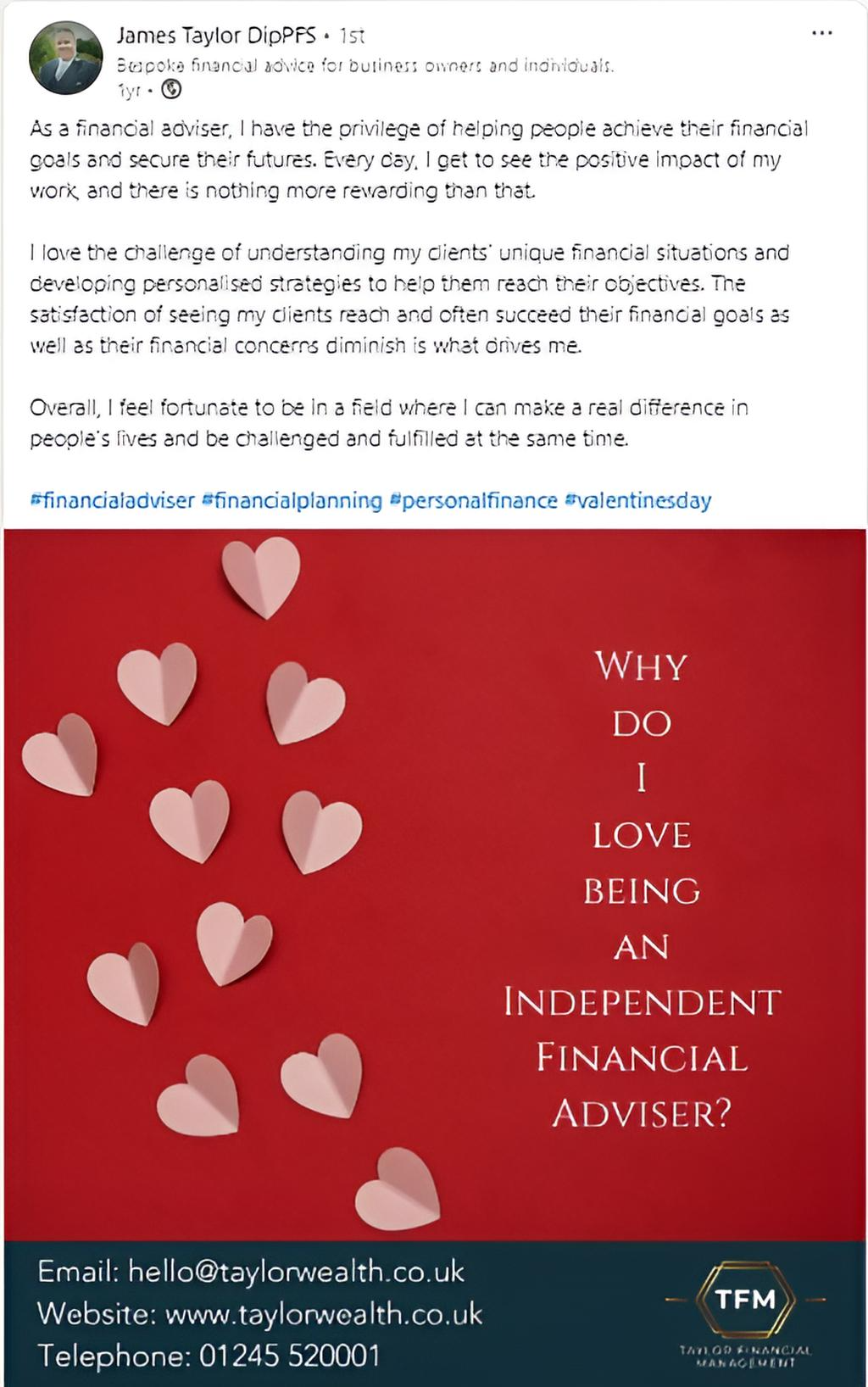

The top image captures the post that garnered significant engagement last year, while the bottom image showcases this year’s post.
Although this year’s Valentine’s post did not perform as well as last year’s, Lindsay still maintains that personal posts are a great way to generate more engagement.
“I always find that personal posts will get a much higher engagement on Social Media. Our client event posts will always do really well too, as it means we can tag companies and people and they like and share the posts for us which increases engagement.”
Lindsay also recommends sharing your VouchedFor reviews on Social Media. Though a lot of IFAs are already doing this, it is important to note that “not many prospects know about this platform” and posting online is a great way to direct prospects to VouchedFor. After all, research finds that around 79% of people trust online reviews as much as personal recommendations from friends and family (you can read more about reviews and their effects on potential customers here).
Which Social Media platforms have proven most effective for reaching your target audience?
Though you may automatically think of LinkedIn as the port of call to promote an IFA business, Lindsay explains that a mix of platforms generate effective results due to each offering unique benefits for the company.
“For us, it has been a mix. Facebook has been great for people recommending us on local business and community pages. Instagram has been great for when we post reels. And actually, both of these platforms work really well when we are promoting our charity ball and selling tickets to people we don’t know.”
According to a study carried out by Taylor Method, Facebook is particularly popular amongst millennials. Millennials are more likely to speak to a financial adviser than any other generation as of December 2023, a study by Professional Adviser found. Regarding Instagram, you may not be surprised to learn that its biggest user demographic is Gen-Z, a younger demographic, who have been reported to be the most-likely generation to seek financial advice on Social Media platforms Instagram and TikTok according to Forbes. As they tend to have less capital, they are more interested in ‘free advice’ on social media as opposed to speaking to an expert.
It is important to understand the audiences on each of your Social channels and how they want to engage with content. Utilising a mix of Social channels will help to attract a wider audience and allow you to showcase your brand to its fullest.
“We tend to put a lot of ‘fun’ content on our Facebook and Instagram stories as well as reels of our events we host.”
This is not to imply that LinkedIn does not also play a vital part in reaching your target audience.
“LinkedIn has been great for connecting with business owners and professional connections as well as those looking to retire and exit their business. Often the high-rate taxpayers come through LinkedIn too. LinkedIn is definitely more about awareness and planting seeds about Financial Planning for clients and prospects.”
What tools or resources do you find most helpful for creating, managing and analysing your Social Media?
“We use Canva to create all our visuals for our Social Media posts. In terms of content, we plan this at the beginning of each quarter to focus on a particular topic, for instance tax year end will be a focus for us now.”
Lindsay tells us that speaking to clients and prospects and paying attention to the press to learn what is ‘relevant’ at the time is key.
“We get ideas from the press as well as from speaking with clients and prospects. This is where we tend to focus on educating people or do some myth busting!”
In terms of engagement, Lindsay uses Meta’s Business Suite to determine what time the business pages’ followers are most active on Facebook and Instagram, and to then set up the majority of their news feed posts on there.
Though LinkedIn does not have a ‘Business Suite’ type feature, LinkedIn allows you to schedule posts which Lindsay says has made marketing on LinkedIn a lot easier. And for analysing results from Social Media, Lindsay does not track these statistics militantly.
“In terms of analysing our Social Media, I look at the analytics, but don’t take them too seriously. In our opinion, we are using Social Media for building brand awareness. Selling Financial Planning is not the same as selling a product so tends to be harder to quantify.”
How do you measure the success of your Social Media marketing efforts in terms of client acquisition and retention?
Taylor said she asks clients where they heard about the firm to gauge which marketing strategies are working best.
“A lot [of clients] will mention that one post we thought hadn’t reached anyone, so it is important to post and keep going, even though you might not see the initial traction.”
Can you provide tips for other independent financial advisers looking to enhance their Social Media presence and marketing strategies?
“So there are just three Social Media goals that you can pick from when it comes to your Social Media strategy. The first one is growing your following.”
Research has shown that the most effectives ways to do this are to engage with your audience (i.e. reply to comments promptly), engage with other pages online, and promoting your Social Media to current customers (you can read more about this at Aspiration Marketing).
“The second one is building awareness or building your brand. And the third one is selling. I would always recommend focusing on the first two.”
Lindsay continues to tell us how to build your online brand.
“Make sure any awards you have been shortlisted for are visible. Although self-promotion is difficult, if you are a one-man band, no one else is going to promote you so make sure you are promoting your reviews and your achievements. Unless you belong to a national networking group, you will find it hard that people aren’t recommending you so PROMOTE YOURSELF!”
Finally, Lindsay recommends that consistent posting is a key factor of enhancing your business’ Social Media pages.
“I would also recommend being consistent with your posting. Three times a week is enough, but make sure you are also interacting with other accounts on whichever Social Media platform you are on.”
To wrap up our Q&A, Lindsay also referred advisers to “Yardstick, who have lots of information on their website. I am also happy for anyone to get in touch if they would like to chat through anything.”
Lindsay can be contacted on her LinkedIn here: Lindsay Taylor.
If you are a Member of ValidPath and would like to get involved with our Member Insights Q&A series, please contact lindsay@validpath.co.uk.